 |
|
|
|||||||||||||||||||||
|
|||||||||||||||||||||||
 |
|||||||||||||||||||||||




















|
|
|
|
|
|
|
|
|
|
 |
|||||||||
|
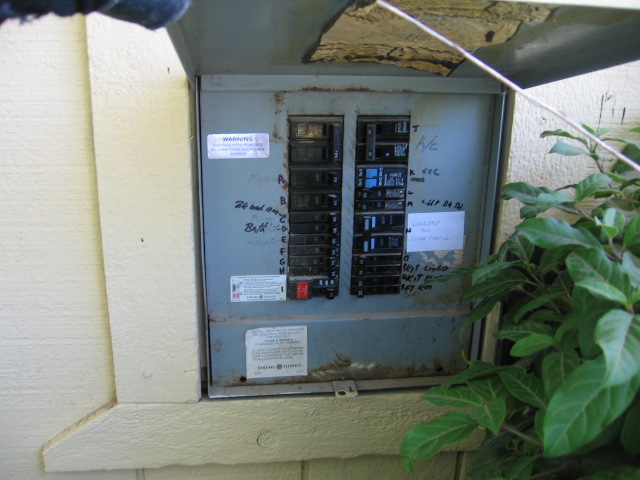
When we bought our house in California, the conventional propane-fired 40 gallon tank water heater was 9 years into its 6 year warranty... It was prime time to get a new source of hot water, but what to choose? The standard answer is another natural gas, propane or fuel-oil tank-based water heater. The downsides of this option are: using a fossil fuel (ugh), paying skyrocketing fossil fuel prices, and having a unit that will live for a maximum of 10 years before I have to do it all again. I want to get rid of all fossil fuels in my life so this would be a big step backward. I seriously looked into solar thermal hot water systems. Our area gets a lot of sunshine even in winter, so it's a realistic choice. Many of my neighbours have an older model with the tank integrated into the panel on the roof, but unfortunately it was early days for those products and they've all failed over the years. I got a quote from a respected local installer, but the system they proposed was quite complex, with two roof thermal panels driving a closed antifreeze loop, heating water in a large inside tank. The system was built with the solar units screwed into the roof, long runs of hard copper piping, a circulator pump driven by a small solar panel, an expansion tank, a relief valve, and the heat exchange/storage tank (which had a surprisingly short warranty). The system was similar to this design. The parts alone, if ordered as a kit from that web site are $4100, but the quote I got from the local installer was $8835 before the federal tax credit. Wow! That's a fortune just to get hot water, and there will be the ongoing need to replace the storage tank. What I ended up with was a tankless electric water heater unit from Stiebel-Eltron. The theory behind these units (and they are also available for natural gas or propane) is there is no tank - the unit heats up the water instantaneously when someone opens a hot water tap in the house. The unit only makes hot water when it's needed, and will keep delivering hot water indefinitely. I chose the electric unit style because I'm making my own free electricity with the solar panels so I have no energy cost. People without a cheap source of electricity will likely make a different choice because when it's making the hottest water it can, it's pulling a maximum of 100 Amps at 240 Volts. That is *serious* power and needs two circuit breakers and two supply wires the thickness of a hot dog. Of course if you set the temperature to a standard level it will use much less power. The first step of the install was to examine the house's current (no pun intended) electric service. Unfortunately it still had 100A service from the original construction in 1978. In addition, there were no spare breaker slots and one of the breakers had a nasty habit of not resetting unless I flicked it on and off about 40 times. It was a good time to put in a fresh new system. |
|||||||||
 |
 |
||||||||
|
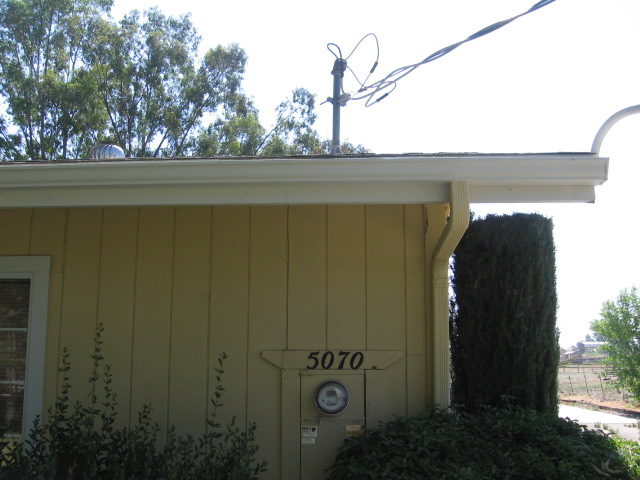
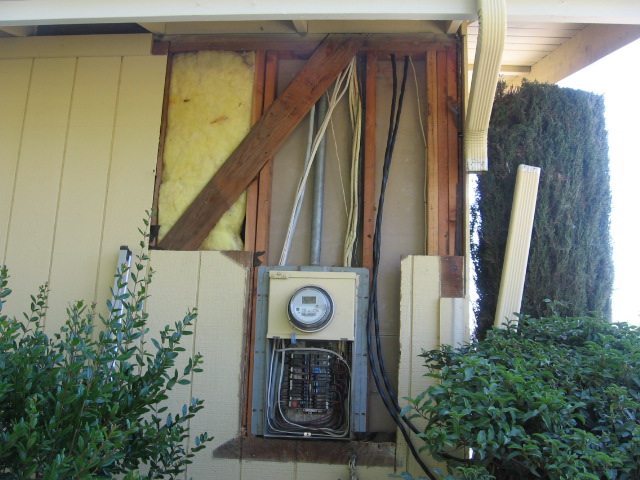
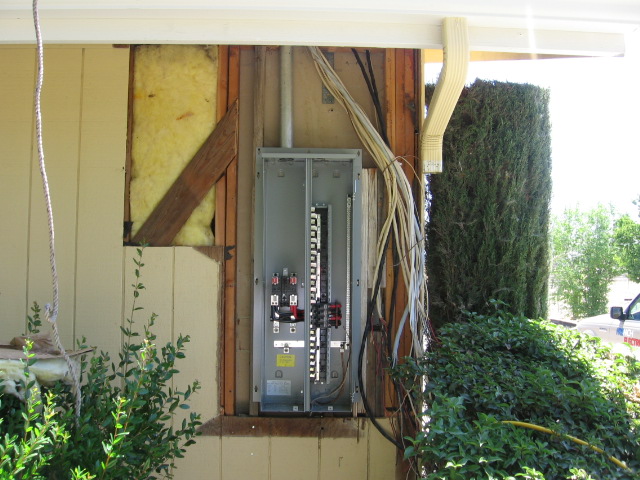
The heater requires two 60A breakers, so we had to upgrade the service to 200A. This required the full replacement of the breaker panel and all new circuit breakers. Fortunately the PG&E wire from the street and the digital meter can support 200A service, but we put in a new pipe through the roof and raised the cable about 2' to meet newer electrical code. I pulled all of the trim away from the wall to give the electrician room to do his thing. |
|||||||||
 |
|||||||||
|
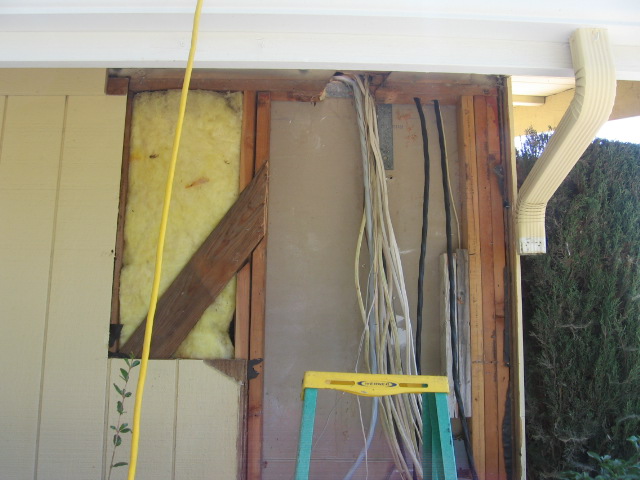
The electrician removed the old panel, reframed for the size of the new panel, screwed in the new panel, installed the existing wires and ran the new wires through the attic, then popped in the new breakers. Did I mention it was record heat that day? |
|||||||||
 |
 |
||||||||
|
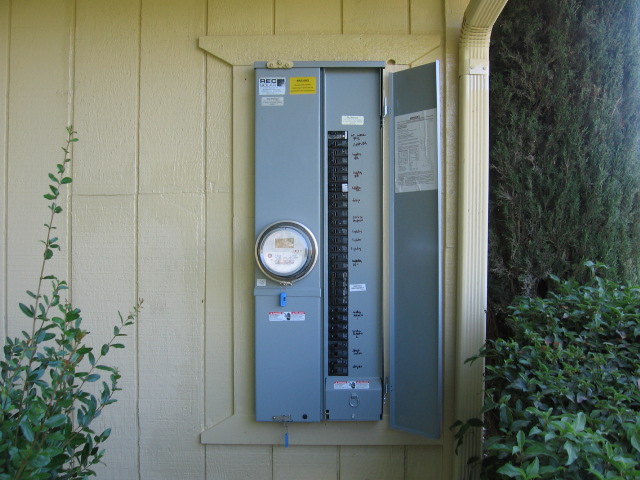
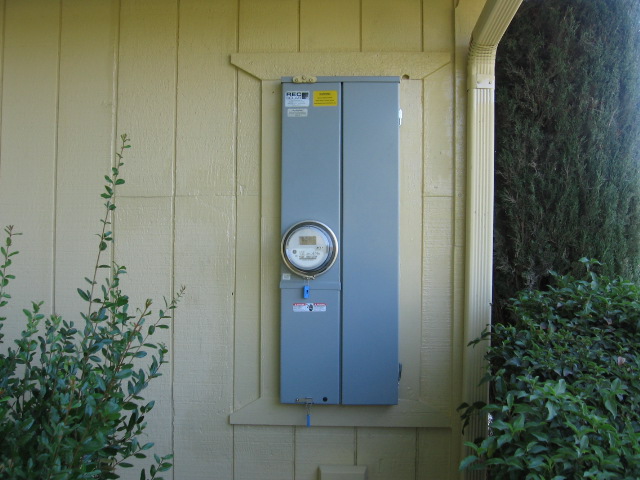
Later I reattached the wallboard and trim, then caulked and painted to get it back close to the original look. Nothing better than a clean, full breaker box! |
|||||||||
 |
 |
||||||||
|
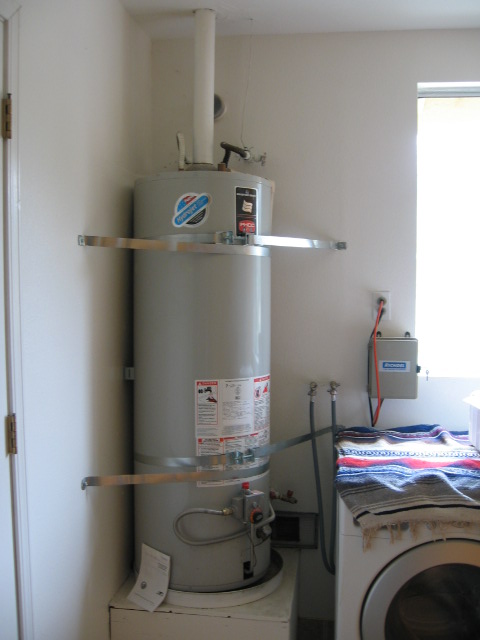
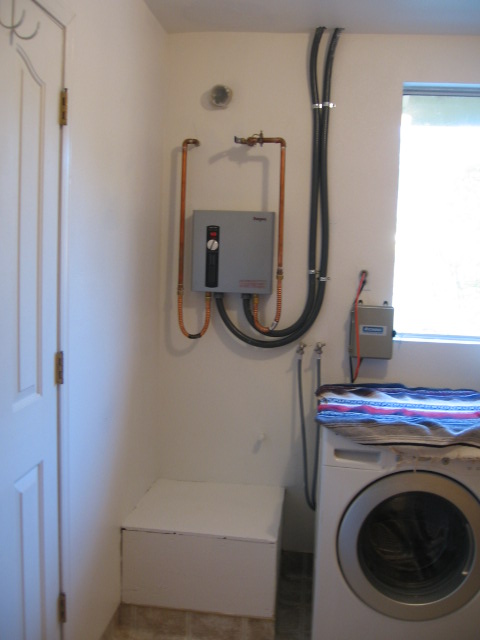
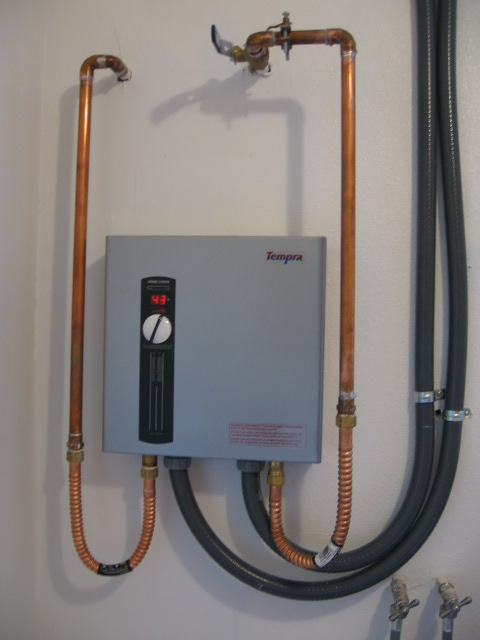
With the breaker work completed, we coordinated with the plumber so he and the electrician would show up on the same morning to complete the install. They worked together to pull out the old heater, then screwed the unit to the wall, installed the power and ran new cold and hot water runs. That's it! It only weighs 22 pounds so the manufacturer provides simple plastic drywall anchors to do the mounting. |
|||||||||
 |
|||||||||
 |
|||||||||
 |
 |
||||||||
|
You can see how compact the unit is compared to the tank, and how straightforward the installation is. The white dial allows you to set the water temperature digitally, from 86F to 125F. The unit automatically works out how much heat it needs to add depending on the temperature of the incoming cold water. So we now have a simple, compact, cost effective, 20 year+ method of making an unlimited amount of hot water. These systems are in common use in Europe and Japan, and are finally catching on here in North America. If you have a source of cheap electricity, I strongly suggest you look into these units. Stiebel seems to be the market leader, but Bosch, Seisco and SETS Systems are also available. If your electricity cost would be prohibitive, but if you still like all of the benefits shown above, you could use the natural gas or propane tankless units from Rinnai, Paloma, Takagi or Rheem. Note that these units are either mounted on the outside of an exterior wall, or mounted on an inside wall with a pipe-in-a-pipe to the outside to bring in fresh air and exhaust the combustion gases. After running the system for over a month now, I have to say I'm quite happy. The hot water is, well, hot! I set the temperature on the low side, then bumped it by 1 degree C several times. We are now sitting at 44C and everyone in the house is happy. I did some real-world power draw testing with one shower on full hot, and this is what I found: Lowest setting: 30C / 86F: 2.1 KW This means if someone has a 10 minute shower at our current setting, the system will consume 1.3 KWh. Calculate at your electricity cost to see what this means to you. At a hypothetical 10c/KWh of grid power, that's 13 cents. Not too bad given the cost of other things these days. Although the heater is rated (and must be wired and have circuit breakers for) 24KW, the system is using significantly less than the maximum, even at the highest temperature. This is due to the unit being adaptive to the incoming water temperature and only heating it enough to reach the user's setting. It's summer now and the normally cold well water is being warmed up through the near-surface piping from the well 4 houses up the street. Power draw will go up slightly in the winter months. An added benefit of replacing the old, rusting tank is a feeling of full rinsing in the shower! With the tank, it never felt like the soap was completely rinsing off, but it was more likely rust, sludge or other stuff in the tank being sent down the pipe with the water.! |
|||||||||